Why Casino Rules Separate the Turn from the Outcome
Casino rules separate a turn from its outcome, helping players follow accepted actions, hand-offs and settlement without mistaking procedure for a prediction.
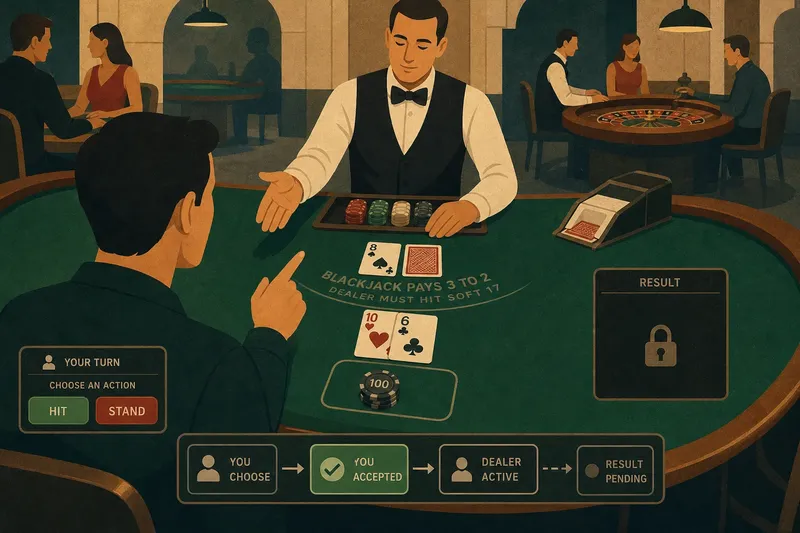
The most common mistake in reading casino rules is to treat a player’s turn and the game’s result as one event. That can make it hard to tell whether an action registered, whether play is still open or whether the round has been settled. Casino rules separate these stages so the procedure can be followed from one action to the next.
In a card room, at a roulette table or on a digital game, a turn is the part of play in which someone may take an available action. The outcome is the result recorded after the relevant actions are complete. For game designers, that distinction is a question of legibility: can a player tell what the system has accepted and what happens next?
Turn boundaries
A turn answers, “Who may act, and what choices are open?” It begins when the game makes an action available to a particular player and ends when that action is accepted, declined or no longer permitted under the rules.
At roulette, the betting period is one such boundary: players may place or adjust permitted bets while it is open, then the table closes betting before the wheel’s result is recorded. At blackjack, a player’s decision is one stage in a sequence, followed by the next player or the dealer’s procedure.
These boundaries help people follow the game’s order. They are not clues about what result will come next.
Action sequence
Rules establish whose action is due, what choices are available and when play advances. A dealer’s acknowledgement, a chip marker or a screen prompt can make the hand-off visible.
Without a clear hand-off, players may speak at once, miss a decision or wonder whether betting is still open. A well-designed sequence shows the current stage, confirms an accepted action and signals who or what acts next.
Make the hand-off visible before showing the next stage.
Accepted actions
Players need a way to distinguish an intended action from one the game has accepted. A tap, spoken instruction or chip movement is not necessarily enough on its own; the interface or dealer should provide a recognisable response under the game’s rules.
For example, a digital table might change the player’s status from “choose” to “waiting” after a valid selection. That small state change tells the player the action has registered, while leaving the later result to its own stage.
Clear confirmation is especially useful when several people act in sequence or when a table is busy.
Casino rules and outcomes
Casino rules define available actions and how play is settled. They do not make the result known before the game reaches its stated settlement point. In roulette, the betting options and the recorded wheel result belong to separate stages; in blackjack, a player’s choice is followed by further play under the table’s rules.
“Your turn” describes an opportunity to act. “The round is settled” describes a later point, when the result has been determined according to the procedure.
Keeping those phrases distinct helps staff, players and designers talk about the same event without implying that an action dictates the result.
Reading the sequence?
When does a turn begin?
A turn begins when the game makes a permitted action available to a particular player. This may be shown by a dealer’s cue, an open betting period or an active control on a screen.
How can I tell an action registered?
Look for the confirmation specified by the game, such as a dealer’s acknowledgement or a changed screen state. If it is unclear, pause and ask staff or check the displayed rules before play moves on.
When is a result settled?
The game’s procedure identifies the settlement point, such as the completion of a hand or the recording of a roulette result. A single player’s turn ending does not necessarily mean the whole round is complete.
What should I do if a result is disputed?
Start with the venue’s published rules and the game’s stated procedure. If the issue remains unclear, ask the dealer or an appropriate staff member how the venue handles the question.
Visible stage cues
At a table, betting areas, chip placement, card positions and a dealer’s gestures can show where an action belongs and when a stage has closed. On a digital table, a highlighted player name, an active choice button and a separate result display can serve a similar purpose.
Say you are watching a blackjack hand at a casino table. The dealer signals a player, the player chooses to stand, and the dealer acknowledges the choice before moving to the next stage. You can see the turn has ended because the action has been confirmed and attention has shifted, not because the eventual result is already known.
Designers can use these cues to make the game’s sequence readable without crowding the table or screen with repeated instructions.
Checks before joining
Before joining an unfamiliar game, check how its stages work. Each observation can guide a practical decision:
- Action order: Check whose turn comes next; if the order is clear, follow it, but if it is unclear, ask the dealer before acting.
- Available choices: Check which actions are permitted at the current stage; if your intended choice is listed, use it, but if it is not explained, ask staff rather than assume.
- Betting window: Check how the table signals that betting is open or closed; if the cue is clear, act only within that window, but if it is unclear, wait and ask before moving chips.
- Accepted action: Check what response confirms an action; if you see the stated acknowledgement, let play continue, but if you do not, pause and ask whether it registered.
- Settlement point: Check which event marks the result as settled; if that event has occurred, follow the displayed result, but if play appears to continue, do not treat an earlier cue as final.
- Dispute route: Check whom to approach about a turn or result; if the dealer can explain the procedure, follow that explanation, but if not, ask an appropriate staff member about the venue’s process.
These checks clarify the procedure and help you decide whether you understand the game’s pace and rules. They cannot tell you what result will occur.
Worked design scenario
Imagine a designer reviewing a digital blackjack screen. In this invented scenario, the starting state is one active player, one unconfirmed choice and a result panel hidden from view. The player taps “stand”; the system changes the choice to “accepted”, moves the active marker to the dealer and keeps the result panel closed while the dealer’s stage is in progress.
Once the dealer’s stage ends under the displayed rules, the system opens the result panel and marks the hand settled. The observable sequence is choice, confirmation, hand-off, then settlement. The design decision is clear: if the player can identify each stage from the screen, the interface communicates procedure; if the result appears before confirmation or the hand-off is missing, the designer should revise those cues.
Readable turn design
A readable turn has a clear beginning, a recognisable choice where one is available and an obvious hand-off to the next stage. The result should appear as a distinct event, with wording or a visual cue that shows when the game has settled it.
For designers, a useful review question is whether a player can describe what they did, what the game acknowledged and what happened afterwards. Casino rules are easiest to follow when those are separate, visible moments rather than a single blur of action.
That same distinction helps when discussing casino rules: identify the action, the acknowledgement and the settlement point before deciding what the game’s sequence means.