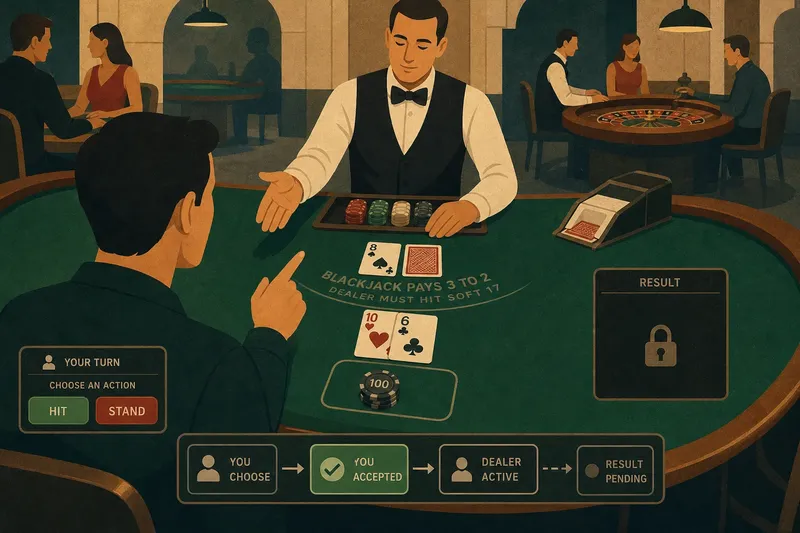
How Casino Stories Became Screen Spectacle
See how casino stories on screen use rooms, entrances and objects to shape a setting’s role, and compare scenes without treating fiction as fact.
The common mistake with casino stories on screen is to treat a roulette wheel, a bright sign and a dressed-up crowd as a complete portrait of casino culture. That shortcut misses how a setting can carry a film’s ideas about status, belonging and who gets to enter. A casino may be a social crossroads in one story and a designed backdrop in another.
Casablanca (1942) and Ocean’s Eleven (2001) offer contrasting fictional settings: one centres a roulette table in Rick’s Café, while the other places a heist plot in a Las Vegas casino. Comparing their storytelling choices is more useful than treating two films as a record of casino history or real venue operations.
Setting and status
In Casablanca, the roulette table is part of Rick’s Café, a setting organised around its owner and the people who gather there. The scene uses gambling as part of a character’s decision, with the social encounter carrying more weight than a tour of a casino floor.
Ocean’s Eleven makes the casino part of a fictional heist plot. Its setting supports a story about characters moving through a controlled environment, rather than offering a neutral account of how a venue works.
The difference is not a simple progression from small rooms to grand displays. It is a choice about what a story makes visible: relationships gathered around a table, or a setting that shapes a larger plot.
Spaces and thresholds
Film-makers can make a space feel prominent through a sweeping view, a passage through connected rooms or a character’s pause at an entrance. A tighter shot may instead hold attention on a face, a hand or a conversation.
Entrances also carry social meaning. A character who is welcomed, watched or stopped at a threshold tells us something about that story’s version of access, even if the script never explains the rules behind it.
Notice who moves through the space, and who remains at its edge.
Genres and objects
A casino can support different kinds of storytelling without making the same claim about real visitors. A crime story may use the venue as a setting for suspicion; a comedy may make a table encounter awkward; a romance may use a crowded room to bring characters together.
Objects help build these meanings. A chip, card, roulette wheel or entrance sign might identify the location, mark a character’s concern or appear only as a quick visual cue. Its significance depends on how the particular story presents it.
Casino language can also travel beyond the setting. When a character calls a negotiation “high stakes”, the phrase may borrow gambling imagery without referring to a game. Check whether the dialogue is literal or figurative before interpreting its role.
Why do casino scenes differ?
What makes a casino scene feel grand?
A broad view, a character’s passage through several spaces or an edit linking different parts of a venue can make the setting feel prominent. These are presentation choices, not evidence about how a real casino is organised.
Does a large setting mean a newer film?
No: intimate scenes and expansive interiors can appear in works from different periods. Compare what a scene is doing rather than using the apparent size of its setting as a date marker.
Why show a character at an entrance?
A threshold can establish who is arriving, who appears to control access or how a character feels about entering. A pause or confident crossing may carry meaning within the story, without establishing a general rule about venues.
Can a film show how casinos really work?
A scripted scene selects details to serve its story and leaves other details outside the frame. Treat it as a designed portrayal unless the work is clearly presented as factual reporting and supports its claims.
Compare scene choices
For a grounded comparison, choose two scenes and note what each actually shows. For every observation, distinguish the visible detail from your interpretation, then decide what the scene leaves uncertain.
- Entrance: Check who crosses the threshold; if someone is stopped or escorted, describe access as part of that scene’s tension, and if no barrier appears, note that the story leaves access unexplained.
- Camera view: Check whether the shot stays close or shows the room; if it stays close, describe its focus on a person or exchange, and if it pulls back, describe the space it reveals without assigning it a real-world function.
- Movement: Check who crosses the space and how; if movement is followed or interrupted, consider whether it supports the scene’s mood, and if characters stay still, consider whether the attention rests on dialogue or reaction.
- Staff: Check whether staff appear and what they visibly do; if a task is shown, describe that action, and if staff are absent, note that routine work remains outside the scene.
- Objects: Check which game objects or signs appear; if an object returns or changes hands, consider its role in the story, and if it appears briefly, treat it as a location cue unless the scene gives it further meaning.
- Sound and editing: Check the music, cuts and reactions; if they encourage a clear mood, describe the cues, and if their effect is mixed, preserve that ambiguity rather than forcing one reading.
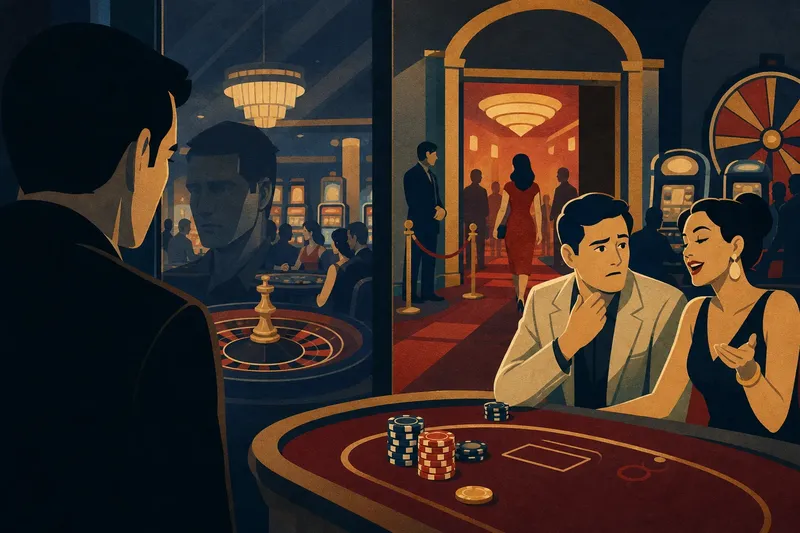
Imagine two invented starting scenes: in the first, a crime-film character waits beside a glass wall; in the second, a comedy visitor hesitates at a gaming table. First, record the visible detail in the crime scene: the character watches a reflection. Decide to describe surveillance as the scene’s suggestion, not as a fact about casinos. Next, record the comedy scene’s cut from the hesitant visitor to a confident speaker. Decide that the contrast may create awkwardness. The resulting comparison is that one invented scene uses observation to build suspense, while the other uses contrasting behaviour for humour; neither supports a claim about real visitors.
Read each story closely
When writing about casino stories on screen, name the work and point to a specific choice, such as a cut to a doorway, a character’s pause or the sound accompanying a table scene. This keeps interpretation tied to what viewers can actually see and hear.
One useful final check is to name both what a scene emphasises and what it leaves out. That distinction helps show whether a casino serves as a meeting place, a symbol of access or a dramatic backdrop, without mistaking a film’s choices for a complete account of casino culture.