A Campus Reading Session for One Casino Scene
A campus reading session for one casino scene helps students explore how rules, expertise and uncertainty shape who can follow the action and why.
The common mistake in a campus reading session about a casino scene is to begin by calling it glamorous, corrupt or absurd. That costs the group a chance to examine how the story frames knowledge: who can act confidently, whose guidance carries weight and what the audience is expected to understand. A campus reading session for one casino scene can focus on those relationships without turning into a verdict on gambling.
Choose a short extract where learning or interpretation affects the action. The purpose is not to catalogue every image, but to discuss how rules, expertise and uncertainty shape the characters’ choices.
Choose a learning question
Look for an exchange in which someone asks how to play, gives an instruction, misreads a signal or disputes what happened. Choose a passage that makes sense on its own, or include the brief context needed to follow it.
Use an authorised library copy, course resource or other lawful source. Before watching, give the group a question to carry through the scene: what does a character need to know in order to act, and who provides that knowledge?
Follow the scene’s teaching
Rather than assigning people to inventory visible details, give them distinct questions about how the scene makes knowledge available. They can compare what the story explains, what characters infer and what remains unresolved.
- Rules: Check whether the scene names the game, explains a turn or clarifies how a result is reached. If a rule is stated, discuss who needs that explanation; if it is skipped, consider what the audience must infer.
- Expertise: Check who gives instructions, corrects another person or acts without explanation. If one character is treated as an authority, ask what makes that role credible in the scene; if authority is disputed, compare the competing accounts.
- Objects: Check whether cards, chips, a betting area, a wheel or a screen help a character understand what to do. If an object’s purpose is explained, discuss how; if it stays obscure, leave the uncertainty open rather than supplying a guess.
- Timing: Check when the audience receives information in relation to a character. If viewers learn first, discuss whether that changes the tension; if they learn alongside the character, consider how the scene positions them.
- Correction: Check whether a mistake is corrected, ignored or made into a joke. If the correction changes what happens, discuss who gains influence; if nobody responds, consider whether the error is treated as minor or left ambiguous.
- Silence: Check whether a question or instruction receives a response. If the character acts afterwards, discuss what the action suggests; if the scene moves on without clarification, note what remains unknown.
These prompts are not a scoring system. Their purpose is to help the group discuss how the scene distributes authority and understanding, rather than settle on a single reading too soon.
Set up the discussion
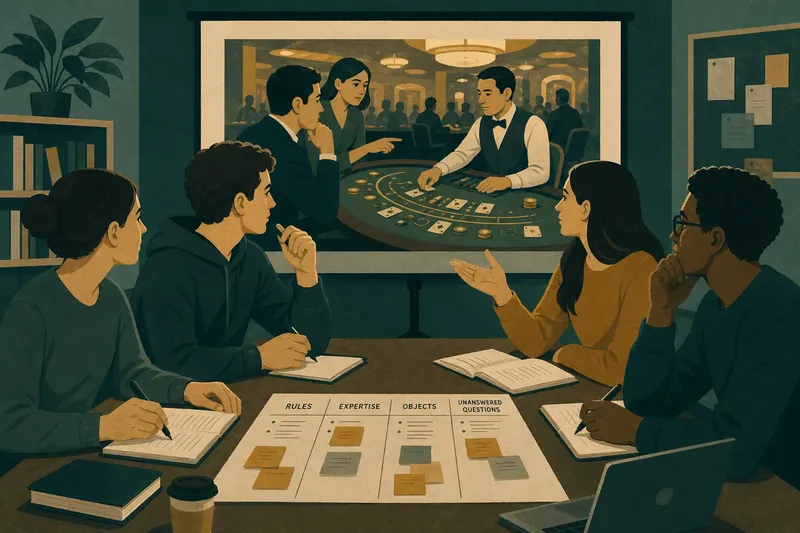
A seminar room, library study space or quiet common room will do. One host can manage playback while another keeps a shared document with columns for rules, expertise, objects and unanswered questions.
Let participants pass on speaking, and do not ask anyone to share personal experiences of gambling. Keep discussion centred on the scene. If the game is unfamiliar, say so; the group can consider whether the story clarifies the rules or relies on viewers to fill gaps.
Watch the extract once without pausing, then allow a short note-taking break. Replay only the exchange that raises the learning question. The host can invite people to connect their interpretation to a character’s instruction, choice or response.
Work through one scene
Imagine an invented scene in which a first-time visitor sits at a card table. A friend tells them to watch the dealer’s hands; the dealer explains when to act but not how the result is decided; the visitor then follows a nearby player’s move instead of asking a question.
To work through it, the group first identifies the visitor’s information gap: they know when to act, but not how the outcome is determined. Next, they compare the sources of guidance: the dealer gives a partial instruction, while the friend directs attention to a gesture. Then they discuss the visitor’s choice to copy another player. The resulting interpretation is that the scene shows participation without full understanding; the group can still disagree about whether the friend’s advice is reliable.
When readings differ, ask what each one explains and what it leaves open. The visitor’s silence could suggest confusion, deference or concentration; keep those possibilities in view unless the scene gives a reason to favour one.
Questions about casino scenes?
What if nobody knows the game?
Ask the group to distinguish what the scene explains from what remains unclear. If the rules are still uncertain, discuss that uncertainty as part of the storytelling rather than guessing at the game.
Should we research the film first?
Begin with the extract so participants can focus on what the scene itself communicates. If later context changes a reading, add it as background and discuss how it affects the first interpretation.
How can the host handle disagreement?
Invite each person to connect their reading to a character’s words, decision or response. If multiple readings fit, keep them side by side and identify what further context might help.
How much of the film should we watch?
Choose an extract with a clear boundary and enough context to follow the exchange. If an earlier scene explains something essential, include that passage or acknowledge that its absence limits the discussion.
Keep claims in proportion
A scene can show how one story represents casino play; it cannot establish how every casino or player behaves. If the discussion raises broader questions about casino culture, note them for another session instead of treating one scene as an answer.
Close by asking each participant to name one question about knowledge or rules they would bring to another scene. A campus reading session for one casino scene is most useful when it helps the group notice how the story makes play understandable, difficult or uncertain.