The Lucky Charm Is Not a Rule: Reading Casino Symbols Carefully
Learn how to read casino symbols by separating lucky imagery from game instructions, so you can identify a symbol’s stated role before you play.
The most common mistake when reading casino symbols is treating a familiar lucky image as a clue about what to do. A clover on a cabinet or a horseshoe beside a game title can encourage a guess, while the useful information sits in the game’s own descriptions.
Casino symbols are part of a visual language: stars, dice, coins and lucky numbers bring familiar associations into a room or onto a screen. Reading them well means asking where the image appears, what the game calls it and how its stated role fits the design.
Casino symbol meanings
A gold coin on a cabinet may be decoration; a coin among the images used in a game may have a named role. The distinction comes from the particular game’s wording, not from the image’s familiar appearance.
Start by noting the image’s location: cabinet, title screen, decorative border, card or active play area. Then look for it in the game’s rules, paytable or information panel, which may describe a function or identify the image as artwork.
Visual design language
Colour, animation and placement give a game its character. A glowing emblem can suggest importance, while a pointing character may draw attention to part of the screen; neither tells you what the game calls that image.
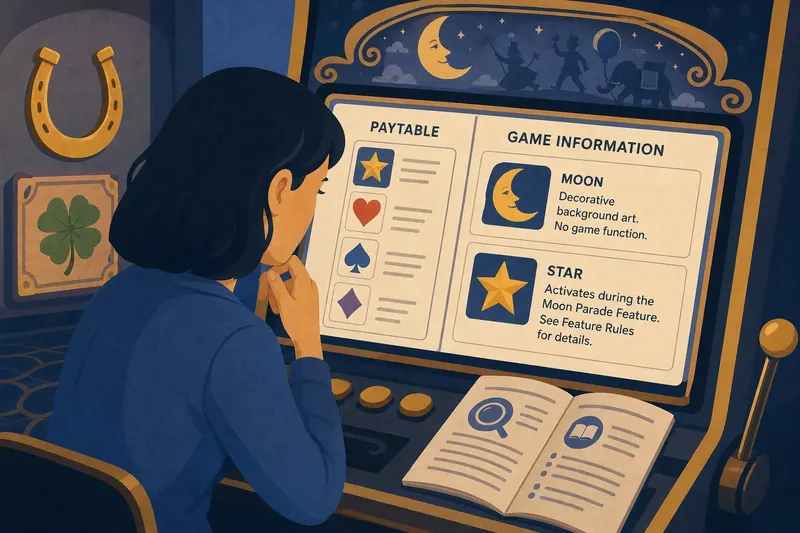
Say you see a moon motif above a row of card images. You open the information panel and find the moon described as background art, while a card symbol has a stated role. The moon contributes to the scene; the card’s description explains how the game uses it.
Read the image in context: its location and the game’s wording matter more than how strongly it stands out.
Symbols across games
The same star can decorate one game, appear as a named symbol in another or be included in a feature in a third. An interpretation from one title does not automatically apply to another.
Check the title and version shown on the screen, then use that game’s instructions. If the wording is unclear, pause and ask the operator or consult the provider’s information rather than filling in a missing meaning from memory.
Luck and expectation
A repeating motif can feel like a sign that a result is due. That feeling comes from the association the image invites; the image itself does not tell you what a later result will be.
Keep the question narrow: what does this game explicitly say the symbol means? Avoid making a decision based on a charm, streak or visual theme. If play stops feeling like entertainment or causes distress, take a break and consider speaking with a qualified support service.
Questions about symbols?
Does a horseshoe mean a win is coming?
No. A horseshoe on a cabinet or screen is not a prediction. Look for a stated role in the game’s instructions instead.
How can I tell if a symbol has a game function?
Search the rules, paytable or information panel for the image or its name. If those materials do not describe a role, do not infer one from its appearance.
Can one image mean different things in different games?
Yes. One game may use an image as decoration and another may give it a named role. Check the instructions for the exact title rather than carrying over an interpretation.
What if the instructions are unclear?
Pause and read the full rules panel or the provider’s information. If the wording still leaves you unsure, ask the operator before continuing.
Symbol reading checks
Use these checks when an image seems to carry a message. Each observation leads to a practical choice without relying on a guess.
- Location: If the image is on the cabinet or in a decorative border, treat it as artwork unless the instructions name a role; if it appears in the active play area, check the rules before assigning one.
- Name: If the rules or paytable identify the image, read that entry; if they do not, leave its meaning unassigned rather than guessing.
- Description: If the instructions explain a function, use that description; if they show the image without explaining it, do not treat it as an instruction.
- Condition: If the stated role applies only during a named feature or circumstance, keep your interpretation within that scope; if no condition is stated, do not invent one.
- Game identity: If the title or version differs from one you remember, use the current game’s instructions; if you cannot identify the game, pause and ask the operator.
- Unclear wording: If the instructions answer your question, use their description; if they remain ambiguous, seek clarification or leave the image uninterpreted.
Imagine a game called Moon Parade with a moon in the border and a star among its active symbols. You note the moon’s location, search the rules panel for both images, and read that the moon is decorative while the star has a role only during a named feature. The resulting decision is to treat the moon as artwork and the star as relevant only in that feature, not as a general signal.
Reading images in context
Casino design can make an image feel familiar before you have read its description: a clover suggests luck, a gold frame draws the eye, and a sparkle gives one part of a screen emphasis. Those associations contribute to the atmosphere, but they are different from the meanings stated for a particular game.
When reading casino symbols, note where an image appears and check what the game calls it. That approach lets the artwork set a mood while the game’s own language answers what the symbol means.